Blog · Systems ·
Optimise once, execute forever: smuggling DataFrames into a compiled Polars plan
Polars re-runs its whole query optimizer on every collect(). For one fixed expression scored against a stream of small batches, that is the entire runtime, so I disguised the input as a file that never existed and skipped the optimizer altogether.
- interactive
- rust
- python
- polars
- query-planning
- performance
I built rtlf, published to PyPI as polars-rt, as an experimental workaround for
pola-rs/polars#25246: I had one Polars
expression (a scoring function, a decision tree, the kind of thing you’d call a feature
pipeline) and a stream of small DataFrames arriving one at a time that all needed the same
expression evaluated against them. Nothing about the expression changed call to call.
Only the data did.
LazyFrame.collect() doesn’t know that. Every call runs the whole Polars optimizer from
scratch (predicate pushdown, projection pushdown, common subexpression elimination, type
coercion, the works) over the entire plan, even though the plan is identical to the one it
optimized a millisecond ago. rtlf’s README states the general shape of the problem plainly:
for a fixed expression applied to a stream of small batches, “this optimization cost
dominates execution time and grows super-linearly with plan complexity.” The benchmark
numbers back that up without needing to be dramatic about it: its linear-chain table
averages 503 ms per call across the 100–999 node range, and reports 1.55 s exactly at
depth 1000, for the same thousand-row batch every time.
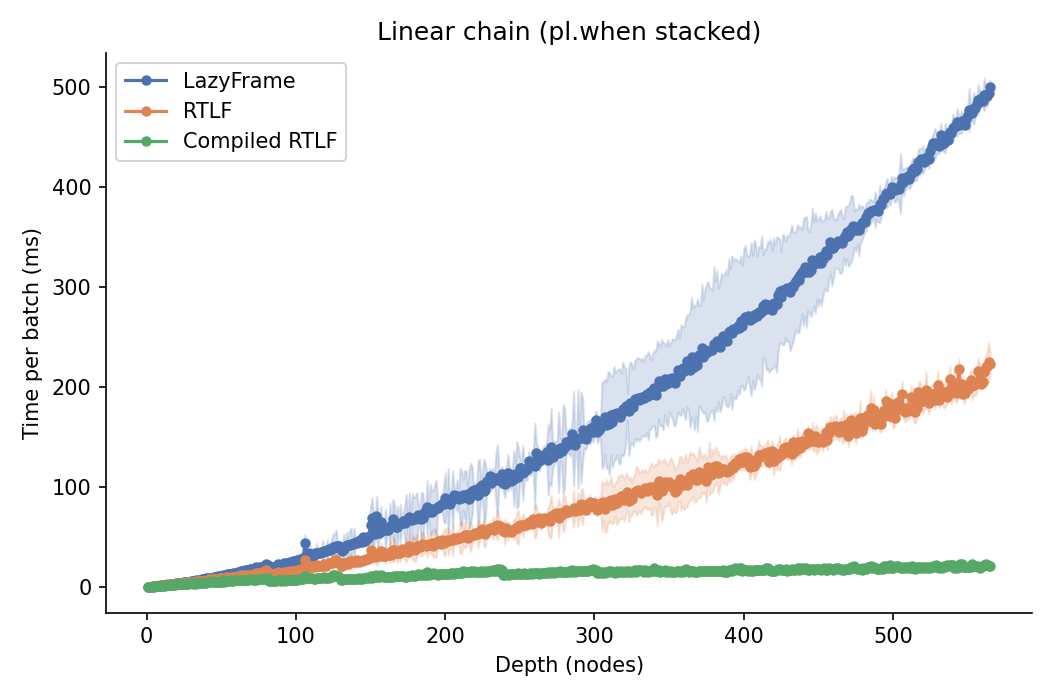
LazyFrame’s time climbs roughly linearly with node count on a linear x-axis, which is what “grows super-linearly with plan complexity” looks like once you stop hiding it behind a log scale.
The fix in this post isn’t a numeric kernel. There’s no SIMD in it, no hand-rolled
parallelism, no custom allocator. The entire optimisation is structural: don’t re-run the
planner. The previous post covers what it took to ship this as a wheel
anyone could pip install: the ABI hash, the 72-job CI matrix, the manifest-rewriting
script. This one is about the 480 lines of Rust that make the trick work, and about the part
of it that’s still a little unsafe.
Attempt zero: just cache the LazyFrame?
The first thing that doesn’t work is the obvious thing. A LazyFrame is a DslPlan:
Scan / Filter / Select / … nodes wrapping the data and the operations you asked for.
The DataFrame you eventually collect is stitched into a Scan node when the LazyFrame
is built, not passed in separately at collect() time. There’s no seam between “the plan”
and “this call’s data” to cache one half of. The optimizer has to see something that looks
like a real data source before it can do anything with the query at all.
So the seam had to be built.
The placeholder trick
read_placeholder() builds a LazyFrame that looks like a Parquet scan to the optimizer
but is not backed by any file on disk:
pub fn read_placeholder(name: &str, schema: &Schema) -> LazyFrame {
    let schema_ref: SchemaRef = Arc::new(schema.clone());

    let sources = ScanSources::Paths(Buffer::from_iter([
        PlRefPath::new(PLACEHOLDER_TOKEN),
        PlRefPath::new(name),
    ]));

    let file_info = FileInfo {
        schema: schema_ref.clone(),
        reader_schema: None,
        row_estimation: (None, usize::MAX),
    };
    let ir_scan = IR::Scan {
        sources: sources.clone(),
        file_info,
        hive_parts: None,
        predicate: None,
        predicate_file_skip_applied: None,
        output_schema: None,
        scan_type: Box::new(FileScanIR::Parquet {
            options: polars_io::parquet::read::ParquetOptions::default(),
            metadata: None,
        }),
        unified_scan_args: Box::new(UnifiedScanArgs {
            glob: false,
            ..Default::default()
        }),
    };

    let scan = DslPlan::Scan {
        sources,
        scan_type: Box::new(FileScanDsl::Parquet {
            options: polars_io::parquet::read::ParquetOptions {
                schema: Some(schema_ref.clone()),
                ..Default::default()
            },
        }),
        unified_scan_args: Box::new(UnifiedScanArgs {
            glob: false,
            ..Default::default()
        }),
        cached_ir: Arc::new(Mutex::new(Some(ir_scan))),
    };

    LazyFrame::from(scan)
}
Two things are doing the actual work here. First, sources is ScanSources::Paths holding
exactly two entries: _rtlf::placeholder (a constant marker, PLACEHOLDER_TOKEN) and the
placeholder’s own name. Polars sees an ordinary two-file scan and optimizes around it
exactly as it would around a real one: pushes predicates into it, includes it in projection
pruning, all of it. Detecting one later is just checking the shape:
pub fn placeholder_name_from_ir(ir: &IR) -> Option<String> {
    if let IR::Scan { sources, .. } = ir {
        let paths = sources.as_paths()?;
        if paths.len() != 2 || paths[0].as_str() != PLACEHOLDER_TOKEN {
            return None;
        }
        Some(paths[1].as_str().to_owned())
    } else {
        None
    }
}
Second, and this is the part that actually stops Polars from touching a filesystem:
ParquetOptions { schema: Some(schema_ref), .. }. Normally a Parquet scan’s schema comes
from reading the file’s own footer, which would mean opening _rtlf::placeholder and
failing immediately. Setting the schema explicitly short-circuits that fetch entirely. The
optimizer gets everything it needs to plan the query (column names, types, row-count
estimate) without ever going near disk, because a file that doesn’t exist has nothing to
be read.
Mode A: patch the arena, every call
RealtimeLazyFrame::new() runs the real optimizer exactly once, at construction, and then
holds onto the two arenas to_alp_optimized() produced (the plan node arena and the
expression arena) along with the arena index of every placeholder scan it found while
walking the optimized tree:
impl RealtimeLazyFrame {
    pub fn new(lf: LazyFrame) -> PolarsResult<Self> {
        let ir_plan = lf.to_alp_optimized()?;
        let lp_top = ir_plan.lp_top;
        let lp_arena = ir_plan.lp_arena;
        let expr_arena = ir_plan.expr_arena;

        let mut placeholder_nodes = HashMap::new();
        for (node, ir) in lp_arena.iter(lp_top) {
            if let Some(name) = placeholder_name_from_ir(ir) {
                placeholder_nodes.insert(name, node);
            }
        }

        Ok(Self { lp_top, lp_arena, expr_arena, placeholder_nodes })
    }
Every subsequent collect() clones both arenas, walks straight to each recorded
placeholder node, and swaps it for a real IR::DataFrameScan holding the DataFrame that
call actually got:
pub fn collect(&self, mut inputs: HashMap<String, DataFrame>) -> PolarsResult<DataFrame> {
    for name in self.placeholder_nodes.keys() {
        if !inputs.contains_key(name) {
            polars_core::error::polars_bail!(
                ComputeError: "placeholder '{}' not provided; got: {:?}",
                name, inputs.keys().collect::<Vec<_>>()
            );
        }
    }

    let mut lp_arena = self.lp_arena.clone();
    let mut expr_arena = self.expr_arena.clone();

    for (name, &node) in &self.placeholder_nodes {
        // Extract schema and predicate before taking a mutable borrow.
        let (schema, predicate) = match lp_arena.get(node) {
            IR::Scan { file_info, predicate, .. } => {
                (file_info.schema.clone(), predicate.clone())
            },
            _ => unreachable!("placeholder node was not IR::Scan"),
        };
        let df = Arc::new(inputs.remove(name).expect("validated above"));
        let df_scan = IR::DataFrameScan { df, schema, output_schema: None };

        if let Some(pred) = predicate {
            // Predicate was pushed into the scan by the optimizer; restore it
            // as an explicit Filter so it actually executes.
            let scan_node = lp_arena.add(df_scan);
            *lp_arena.get_mut(node) = IR::Filter { input: scan_node, predicate: pred };
        } else {
            *lp_arena.get_mut(node) = df_scan;
        }
    }

    let mut physical_plan = create_physical_plan(
        self.lp_top, &mut lp_arena, &mut expr_arena,
        Some(polars_stream::build_streaming_query_executor),
    )?;
    physical_plan.execute(&mut ExecutionState::new())
}
That if let Some(pred) = predicate branch is worth pausing on, because skipping it is the
kind of bug that doesn’t announce itself. If the query has a .filter(...) anywhere near
the placeholder, predicate pushdown (one of the optimizer passes that already ran, once,
at construction) will have folded that filter straight into the scan node’s predicate
field, and deleted the standalone Filter node it came from. That’s normal, correct
optimizer behaviour for a real file scan: a Parquet reader can skip row groups using a
predicate, so pushing it into the scan is strictly better.
But IR::DataFrameScan cannot apply a predicate. It has no predicate field to put one in.
It just is the DataFrame. If collect() swapped the placeholder for a bare
DataFrameScan and dropped the predicate on the floor, the query would still run, still
produce a DataFrame, and just quietly contain rows that should have been filtered out.
No panic, no error, no strict=False xfail to catch it: a silently wrong answer. The fix
is the four lines above it: wrap the new DataFrameScan in an explicit IR::Filter holding
the predicate that got pushed down, so the row-level filtering that used to happen for free
inside the scan now happens as its own step, and the result is correct instead of merely
plausible-looking.
Mode B: compile once, inject by slot
Mode A eliminates the optimizer but still clones both arenas and calls
create_physical_plan on every collect(). For a fixed plan, that’s still redundant work:
the physical plan built from an unchanging IR is itself unchanging. CompiledRealtimeLazyFrame
goes one step further: build the executor tree exactly once, and find a way to get fresh
data into an already-built tree without touching it again.
The mechanism is a function-pointer hook Polars already exposes,
StreamingExecutorBuilder, which create_physical_plan calls once per scan node while
building the executor tree. Passing placeholder_builder as that hook means the compiler
itself is what intercepts each placeholder, not a later patch pass:
pub fn placeholder_builder(
    node: Node,
    lp_arena: &mut Arena<IR>,
    expr_arena: &mut polars_utils::arena::Arena<polars_plan::plans::AExpr>,
) -> PolarsResult<Box<dyn Executor>> {
    let ir = lp_arena.get(node);
    let name = placeholder_name_from_ir(ir);
    let projection: Option<SchemaRef> = if name.is_some() {
        if let IR::Scan { output_schema, .. } = ir { output_schema.clone() } else { None }
    } else {
        None
    };

    if let Some(name) = name {
        let slot: Slot = Arc::new(Mutex::new(None));
        PLACEHOLDER_REGISTRY.with(|r| {
            r.borrow_mut()
                .as_mut()
                .expect("placeholder_builder called outside of CompiledRealtimeLazyFrame::from_parts")
                .insert(name, slot.clone());
        });
        return Ok(Box::new(PlaceholderExec { slot, projection }));
    }
    polars_stream::build_streaming_query_executor(node, lp_arena, expr_arena)
}
Every placeholder scan becomes a PlaceholderExec wrapping a Slot
(Arc<Mutex<Option<DataFrame>>>); every other node (joins, group-bys, real file scans)
falls straight through to Polars’ own build_streaming_query_executor. At execute time,
PlaceholderExec just takes whatever DataFrame is sitting in its slot:
impl Executor for PlaceholderExec {
    fn execute(&mut self, _state: &mut ExecutionState) -> PolarsResult<DataFrame> {
        let df = self.slot
            .lock()
            .expect("placeholder slot poisoned")
            .take()
            .ok_or_else(|| {
                polars_core::error::polars_err!(
                    ComputeError: "placeholder slot empty — collect() was not called before execute()"
                )
            })?;

        if let Some(schema) = &self.projection {
            let cols: Vec<_> = schema.iter_names().cloned().collect();
            Ok(df.select(cols)?)
        } else {
            Ok(df)
        }
    }
}
That leaves one problem: placeholder_builder is a bare fn pointer, because that’s the
type StreamingExecutorBuilder demands. A bare function pointer has no environment: it
cannot close over a HashMap the way a closure could, so there’s no direct way for
create_physical_plan’s caller to get the slots it just created back out. The fix is a
thread-local acting as a side-channel purely for the duration of one compile call:
thread_local! {
    pub static PLACEHOLDER_REGISTRY: RefCell<Option<HashMap<String, Slot>>> =
        const { RefCell::new(None) };
}
CompiledRealtimeLazyFrame::from_parts arms it right before compiling, and drains it right
after:
PLACEHOLDER_REGISTRY.with(|r| *r.borrow_mut() = Some(HashMap::new()));

let physical_plan = create_physical_plan(
    lp_top, lp_arena, expr_arena,
    Some(placeholder_builder as StreamingExecutorBuilder),
)?;

let placeholder_slots = PLACEHOLDER_REGISTRY
    .with(|r| r.borrow_mut().take())
    .unwrap_or_default();

Ok(Self { physical_plan: Mutex::new(physical_plan), placeholder_slots })
I don’t love this. A thread-local that only makes sense while a specific function further
down the call stack is executing, written to by a callback with no idea it’s being watched,
is exactly the kind of “why is this ugly” code that needs a comment explaining it’s not an
accident, and it has one. But it’s not a workaround for bad design on rtlf’s side; it’s
the direct consequence of StreamingExecutorBuilder being a fn pointer and not a
Box<dyn FnMut(...)>. Given that constraint, a thread-local side-channel is close to the
only way to get state out of a callback that can’t capture any.
The predicate-pushdown subtlety from Mode A applies here too, but it’s handled once, at
compile time, rather than on every call: from_parts walks the arena for placeholder scans
carrying a pushed-down predicate and re-lifts each one into an explicit IR::Filter before
create_physical_plan ever runs. The compiled executor tree is built with the filter
already in the right place; collect() never has to think about it again:
pub fn collect(&self, mut inputs: HashMap<String, DataFrame>) -> PolarsResult<DataFrame> {
    for name in self.placeholder_slots.keys() {
        if !inputs.contains_key(name) {
            polars_core::error::polars_bail!(
                ComputeError: "placeholder '{}' not provided; got: {:?}",
                name, inputs.keys().collect::<Vec<_>>()
            );
        }
    }

    let mut plan = self.physical_plan.lock().expect("executor mutex poisoned");

    for (name, slot) in &self.placeholder_slots {
        *slot.lock().expect("placeholder slot poisoned") = inputs.remove(name);
    }

    plan.execute(&mut ExecutionState::new())
}
No clone. No arena walk. No create_physical_plan. Every call is a HashMap drain into a
handful of mutexes and one execute() on a tree that was built exactly once.
The rejected design
That slot mechanism wasn’t the first thing I tried, and I can date almost exactly how long
the earlier version survived. The first attempt routed DataFrames through ExecutionState’s
built-in DataFrame cache instead of a hand-rolled slot, the sanctioned Polars mechanism for
handing a physical plan pre-computed data:
struct PlaceholderExec {
    id: UniqueId,
}

impl Executor for PlaceholderExec {
    fn execute(&mut self, state: &mut ExecutionState) -> PolarsResult<DataFrame> {
        Ok(state.get_df_cache(&self.id))
    }
}

pub fn collect(&self, inputs: HashMap<String, DataFrame>) -> PolarsResult<DataFrame> {
    // ...
    let mut state = ExecutionState::new();
    for (name, id) in &self.placeholders {
        // hit_count = 1: each placeholder is used exactly once per collect.
        state.set_df_cache(id, inputs[name].clone(), 1);
    }
    self.physical_plan.lock().expect("executor mutex poisoned").execute(&mut state)
}
It worked. Seventy-nine seconds later, by the clock on my own commits, it was gone,
replaced by the Arc<Mutex<Option<DataFrame>>> slot design this post has been describing
all along. My commit message at the time says why, typos and all: “change to slots for
better perfomance zero df copy”. state.set_df_cache(id, inputs[name].clone(), 1) clones
the DataFrame into the cache on every call; the slot version moves it: inputs.remove(name)
straight into *slot.lock().unwrap() = ..., no clone, no Arc refcount bump on the frame
itself. The ExecutionState cache is the API Polars actually publishes for this (indexed
by UniqueId, with a hit-count so the cache knows when an entry is spent), and it was
measurably slower than a plain mutex the sanctioned API doesn’t need to know about, for the
mundane reason that “the sanctioned way” carries indirection (a cache lookup by ID, an
allocation per entry) that a private field on a struct doesn’t have to pay for. The slower,
more “correct” version never really shipped: it lived for under two minutes before I
replaced it.
Where it breaks, and why that’s the interesting part
Reusing a compiled executor tree only works if every executor in it is safe to run twice.
Most are. Some aren’t, and the reason is structural rather than a bug that could plausibly
get fixed later: Executor::execute takes &mut self, and Polars’ streaming executors were
written for a tree that gets built once and executed once, so several of them treat that
first execute() as consuming something.
Union’s streaming implementation drains a one-shot channel: reading it a second time
reads nothing. A cross join materialises its right-hand side once on the assumption it will
be read exactly once after that. An asof join’s sort/merge step isn’t idempotent. A sort
under maintain_order=True can carry state that doesn’t reset between runs. A real file
scan (scan_parquet, scan_csv, scan_ipc) owns a streaming file cursor that isn’t
rewound between calls, because normally there’d only be one call. None of this is a
rtlf bug to fix; it’s what “an executor tree” means when nothing in its design anticipated
being asked to run twice.
rtlf’s README turns this into an actual table rather than a paragraph of caveats, and its own test suite turns that table into a test:
@pytest.mark.xfail(
    reason="CompiledRealtimeLazyFrame reuses the physical executor tree; polars' "
           "union/concat executor is stateful and cannot be re-executed. Use "
           "RealtimeLazyFrame for queries involving concat/union.",
    strict=False,
)
def test_two_placeholders_compiled():
    schema = pl.Schema({"v": pl.Int32})
    lf_a = placeholder("a", schema)
    lf_b = placeholder("b", schema)
    compiled = rtlf(pl.concat([lf_a, lf_b])).compile()

    r1 = compiled.collect({"a": pl.DataFrame({"v": [1]}), "b": pl.DataFrame({"v": [2]})})
    r2 = compiled.collect({"a": pl.DataFrame({"v": [9]}), "b": pl.DataFrame({"v": [8]})})
    assert sorted(r1["v"].to_list()) == [1, 2]
    assert sorted(r2["v"].to_list()) == [8, 9]
strict=False means this test is allowed to pass: on a future Polars version where
Union’s executor happens not to be stateful, it would, and CI wouldn’t fail. Until then, it
documents the exact failure mode instead of just asserting it: this specific query, compiled,
breaks on the second call, not the first, because the first call is indistinguishable from
the tree’s intended one-shot use. That’s a genuinely good use of xfail: not “this doesn’t
work yet,” but “this can’t work by construction, here’s the proof, tell me the moment that
stops being true.”
That’s the shape of the whole project: RealtimeLazyFrame re-derives the physical
plan from a stored IR on every call, so it’s always safe: a fresh executor tree every time,
just without the optimizer pass. CompiledRealtimeLazyFrame reuses the tree itself, which is
where the real speedup lives, and that’s exactly the part of Polars that was never designed
to be reused. That caveat table isn’t a list of bugs to fix later. It’s the actual
boundary of what “compile once” can mean for a system whose execution layer assumes it
runs once.
Results
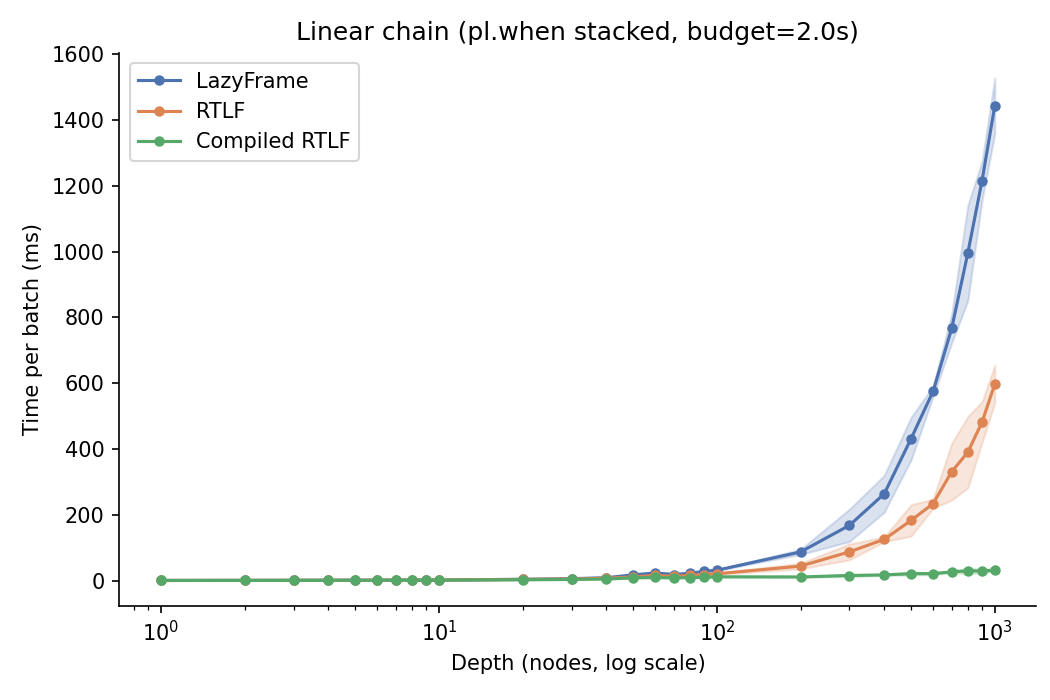
The same linear-chain benchmark on a log-x axis, out to the full depth-1000 range the budget-based early stop allowed. Compiled RTLF stays under 40 ms the whole way.
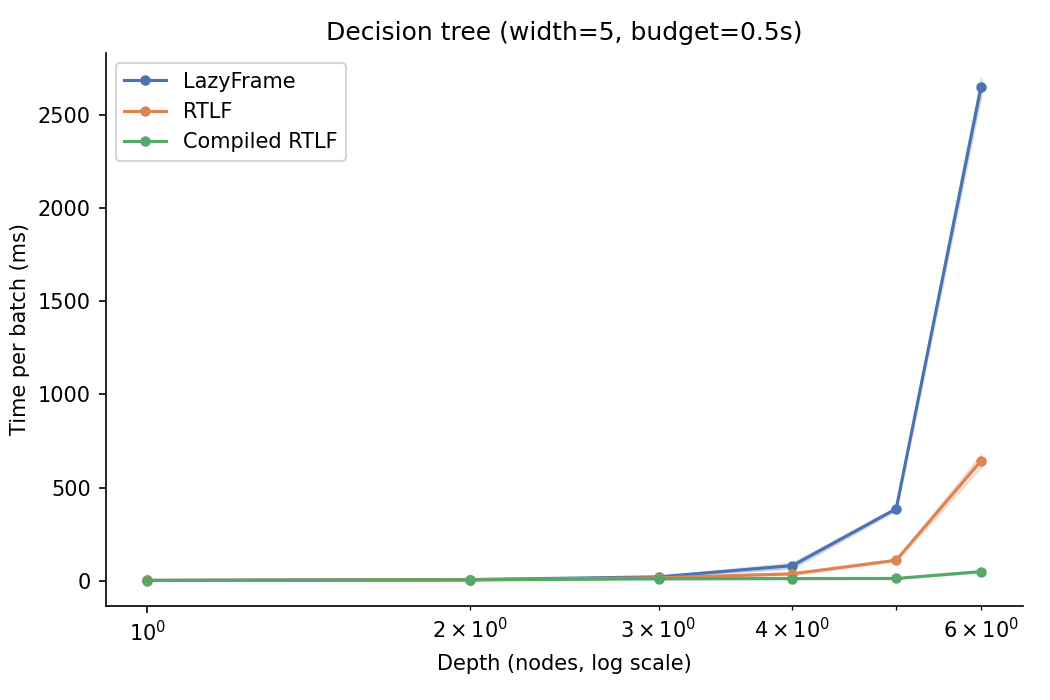
The decision-tree benchmark: node count is exponential in depth, so the y-axis blows up by
depth 6 for plain LazyFrame while Compiled RTLF barely moves.
There’s a small surprise buried in build_dtree_expr, too. “Width-5 tree” suggests
node count grows as 5^depth, but the generator actually does this:
def build_dtree_expr(max_depth: int, width: int = 5):
    """Exponential tree from benchmark.py."""
    def _build(depth=0):
        if depth >= max_depth:
            return make_leaf()
        expr = pl
        for wi in range(width):
            expr = expr.when(pl.col(f"feat_{depth}") < wi).then(_build(depth + 1))
        return expr.otherwise(_build(depth + 1))
    return _build()
Five .when(...).then(...) branches inside the loop, plus one more .otherwise(...) after
it: six recursive calls to _build(depth + 1) per level, not five. And unlike the linear
chain’s build_linear_expr (which is @cache-decorated), build_dtree_expr isn’t
memoised, so each of those six calls independently builds its own subtree rather than
sharing one. Node count is 6^depth, not 5^depth: 55,987 individual _build() calls by
depth 6, not the 15,625 a literal reading of “width-5” would suggest. The widget below gets
this right: it’s ported straight from the function above, not from the name of it.
Plan Cost Explorer
Depth and shape drive four linked views: the Python source the benchmark script would
actually generate for that plan, the exact node count, an inline-SVG plan graph that fans
out fast enough to watch, and a cursor on the replotted benchmark curves. A third control,
batch size, feeds a small model of how a collect() call’s time splits between planning and
execution, clearly marked as a model layered on the measured numbers, not a new
measurement, since rtlf’s README only ever measured batch size 1000.
With JavaScript on, this becomes a shape and depth control (linear chain, or width-5 decision tree) driving four linked panels: the generated Python source, the exact node count, an SVG plan graph that visibly explodes past a couple of levels of the tree, and a cursor on the replotted README benchmark curves showing the speedup at that depth, interpolated between the measured points in rtlf’s README where the reader’s chosen depth doesn’t land on one exactly, and labelled as such. A batch-size control estimates how that time would split between planning and execution at a batch size other than the 1000 rows the benchmark actually measured.
Watching one collect() call
The code above is easier to hold in your head as a diagram than as two collect()
implementations read side by side, so here’s the same contrast as a step-through: the
uncompiled path’s clone-and-patch against the compiled path’s slot fill, five stages, one
step index driving both.
With JavaScript on, Step (or Play, motion permitting) walks through both
collect() implementations in lockstep: IR::Scan(placeholder) → clone
arena → patch to IR::DataFrameScan (re-lifting the predicate where one was
pushed down) → create_physical_plan → execute, next to the compiled path’s
slot.lock() = df → execute, sitting idle through the stages the uncompiled
path is still doing real work in.
The general shape of it
Nothing in rtlf is about DataFrames specifically. It’s about the fact that “figure out what
to do” and “do it” are different costs, and a system that pays the first cost on every call
is only correct, not fast, whenever the plan doesn’t change between calls. A query engine’s
optimizer, a regex engine’s NFA-to-DFA compilation, a shader pipeline’s compile-then-dispatch
split, all of them have exactly this shape, a planning phase whose cost is a function of
the plan’s structure and an execution phase whose cost is a function of the data, and all of
them get faster the same way: do the planning once, keep whatever it produced, and make sure
what it produced can actually accept new data without being rebuilt.
That last clause is the part rtlf hasn’t fully solved. Mode A always
can: it rebuilds the physical plan every time, so there’s nothing left to go stale. Mode B
can’t, for exactly the set of operations rtlf’s own caveat table names, because the executors
underneath were never written with reuse in mind. The interesting engineering here wasn’t
finding a workaround for that; it was finding the version of “compile once, execute forever”
that states plainly where the “forever” stops.